Homophones
#language #kanji A homophone is a word that is pronounced the same as another word but differs in meaning or in spelling.
Opinion and Hypothesis
Learning Japanese as my third language (fourth, if you count Javanese), I have always found that the limited sounds in Japanese (read gojūon) creates so many homophones. The vocabularies that exist in the Japanese language is closely related to Mandarin Chinese, due to the use of Kanji (or Hanzi). However, Japanese only uses the same characters, and not sounds. In fact, sounds that exist in the Japanese language fails to reproduce all the different consonants, vowels, and tones from Chinese. Let’s see an example below.
| Chinese character | Meaning | Japanese sound | Mandarin sound (Pinyin) |
|---|---|---|---|
| 声 | voice | sei | shēng |
| 姓 | surname | sei | xìng |
| 精 | spirit, energy | sei | jīng |
| 省 | reflect, province | sei/shō | shěng / xǐng |
| 静 | quiet | sei | jìng |
| 勢 | power, force | sei | shì |
| 政 | politics | sei | zhèng |
| 整 | organize, neat | sei | zhěng |
| 性 | nature, gender | sei | xìng |
| 生 | life, birth | sei | shēng |
| 正 | correct, proper | sei | zhèng |
| 清 | clear, pure | sei | qīng |
| 青 | blue, green, youthful | sei | qīng |
| 成 | become | sei | chéng |
| 請 | ask, request | sei | qǐng |
Despite some exceptions, the 18 characters have distinct sounds in Mandarin, which are perfectly distinguishable by Mandarin speakers. However, almost all 18 characters have the same indistinguishable reading in Japanese. It is important to note that, however, most Chinese characters are used in along with other Chinese characters, creating more combinations. Let’s take a look at the same phenomenon in a 2-character pair words.
| Chinese character | Meaning | Japanese sound | Mandarin sound (pinyin) |
|---|---|---|---|
| 公正 | fairness | こうせい | gōngzhèng |
| 恒星 | fixed star | こうせい | héngxīng |
| 更生 | rehabilitation | こうせい | gēngshēng |
| 校正 | proofreading | こうせい | jiàozhèng |
| 構成 | composition | こうせい | gòuchéng |
The reading こう (kou) is very common in Japanese kanji, and the table above showing 5 words that readこうせい (kousei) of the same meaning.
You may blame the Japanese language for this flaw, but this is not only unique to Japanese. In English, the word match as a noun has at least 4 meanings.
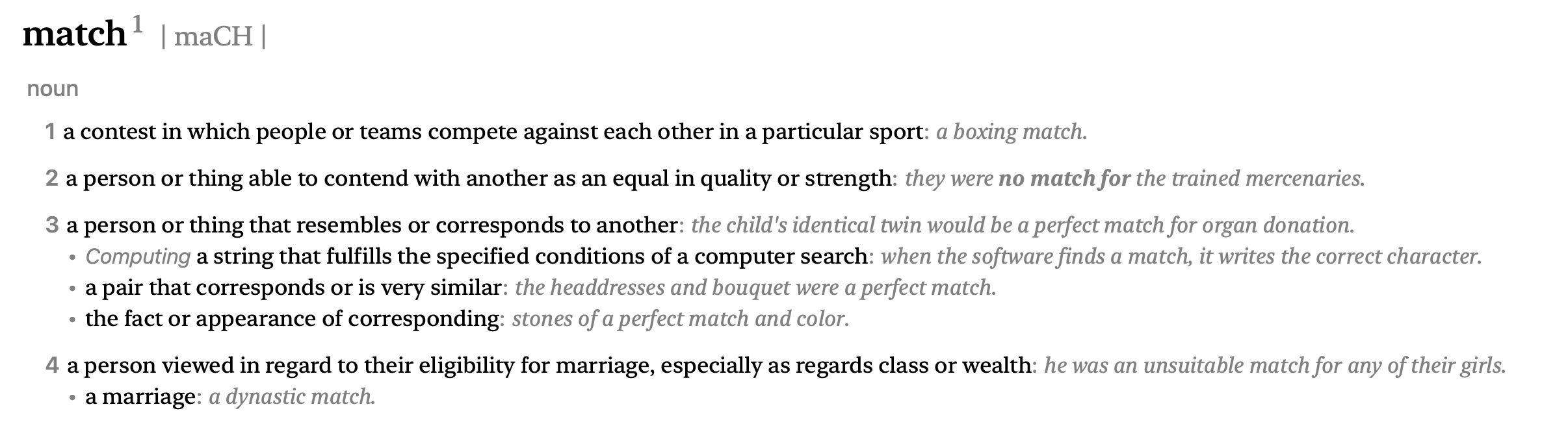
Apple Dictionary registers four different meanings for the noun ‘match’ in English.
In fact, the English example not only has the same sound (pronunciation), but also the same writing. This makes pinpointing the meaning of the word match entirely contextual in literature. On the other hand, due to the use of kanji in Japanese writing, all examples can easily be distinguished from one another, eliminating the confusion.
On a quest to judge the efficiency of a language, one must put away their biases. However, it’s difficult to eliminate all biases, as most people only have one native language (read simultaneous bilingualism). As you might have experienced, even if you’re fluent in more than a language, you will tend to count or read numbers in your first language. This highlights the necessity of establishing scientific methods to measure the efficiency of a language. However, humans are not all-efficient machines. We don’t wait until a language is perfected before releasing it to the mass. We move on despite the flaws in our mother tongues.